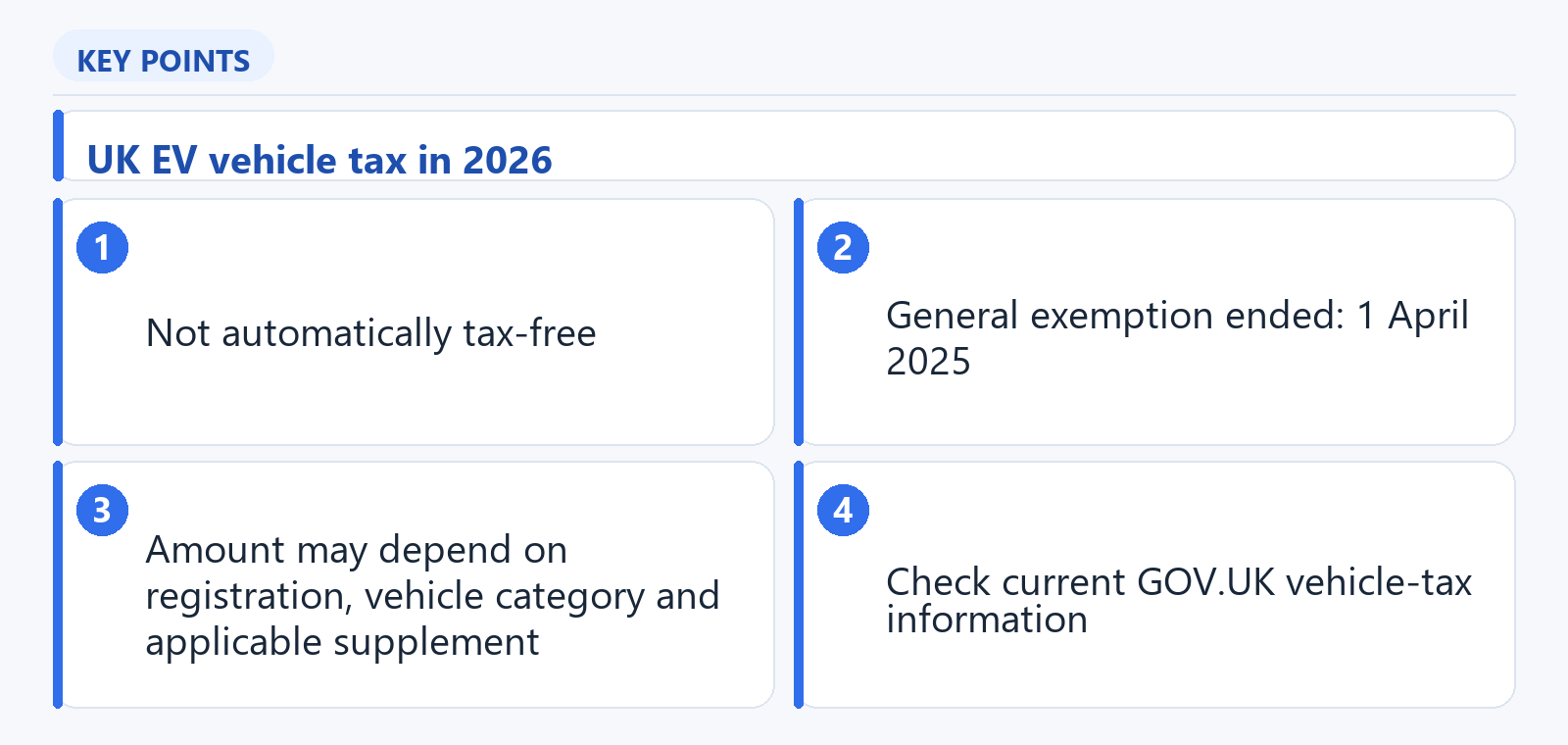
Short answer: electric cars are not generally road-tax-free in the UK in 2026. The general exemption ended on 1 April 2025, so an electric car normally needs to be taxed. However, there is no single universal 2026 amount for every EV: the applicable vehicle tax can depend on the vehicle’s category, registration circumstances and whether a supplement applies.
The tax-status change is supported by current GOV.UK guidance. The available evidence does not include a complete, authoritative 2026 rate table, so treat published figures as indicative until you confirm the vehicle-specific amount through the current GOV.UK vehicle-tax information.
What changed for electric cars?
Electric cars ceased to be generally exempt from vehicle tax from 1 April 2025. That means the relevant question in 2026 is usually not whether an electric car must be taxed, but which vehicle-tax treatment and amount apply to that particular car.
This should not be confused with the vehicle being formally taxed or registered for tax purposes. An electric car should not be assumed to have a zero charge simply because it has an electric powertrain.
GOV.UK guidance also identifies a continuing exemption for heavy goods vehicles over 3,500kg. That is a specific vehicle-category exception and should not be extended to ordinary electric cars. Hybrid vehicles should likewise not be assumed to receive exactly the same treatment as fully electric cars.
How much is electric-car road tax in 2026?
There is no safely supportable single figure for all UK electric cars. Secondary 2026 summaries give examples such as:
| Vehicle or tax situation described in secondary guidance | Indicative figure reported | Important qualification |
|---|---|---|
| A first-year category | £10 | Secondary-source guidance; confirm the vehicle’s applicable official category |
| A standard category | £200 | Not a universal EV rate and not a substitute for the current official rate information |
| Some cars registered before April 2017 | £20 | Depends on the relevant registration and tax category |
| A standard amount plus an expensive-car supplement | Up to about £640 in one summary | The supplement, threshold and effective-date details are not consistently established in the available evidence |
These figures are included to explain the range of amounts discussed in current secondary guides, not as a complete 2026 legal rate table. The available guides are not fully consistent, and the evidence does not resolve every threshold or effective-date detail for the expensive-car supplement.
Before budgeting for a purchase or taxing a vehicle, check the current GOV.UK vehicle-tax information using the car’s registration details. That is the appropriate way to establish the amount and status for an individual vehicle.
What determines the amount?
The relevant treatment may depend on several vehicle-specific factors:
- Registration date: older and newer vehicles can fall into different tax categories. A car registered before April 2017 may not be treated in the same way as a later-registered vehicle.
- Vehicle category: the rules for an ordinary passenger car should not be assumed to apply to heavy goods vehicles or other categories.
- First-year treatment: secondary guidance describes a separate first-year amount for some vehicles, but the exact applicable amount should be checked against current official information.
- Expensive-car supplement: some higher-list-price vehicles may attract an additional charge. The available secondary sources conflict over the relevant threshold and timing, so those details should not be treated as settled without official confirmation.
- Current tax status: the fact that a vehicle is electric does not, by itself, establish that it is exempt or that its charge is zero.
The car’s fuel type is therefore only one part of the answer. Registration history and the vehicle’s official category can materially change the result.
How to check and arrange tax for an electric car
For a vehicle-specific answer:
- Use the current vehicle-tax information and taxing process on GOV.UK.
- Check the vehicle using its registration details rather than relying on a general EV rate.
- Confirm the displayed tax status, amount and effective treatment before relying on the result for a purchase or payment decision.
- If the official record conflicts with a published guide, use the current official record and guidance as the reference point.
A general article cannot determine the exact liability for a particular car without its vehicle details and the current official information.
Bottom line
In the UK, electric cars are generally subject to vehicle tax in 2026 because the general EV exemption ended on 1 April 2025. The amount is not one flat EV rate: it may vary with registration date, vehicle category and any applicable supplement.
Secondary guides report figures including £10 for a first-year category, £200 for a standard category and £20 for some pre-April-2017 cars, but these are not a complete primary 2026 rate table. The expensive-car supplement is particularly unsuitable for an unqualified answer because the available sources disagree about its threshold and timing.
For the final amount or tax status of a specific electric car, check the current GOV.UK vehicle-tax information.