The short answer
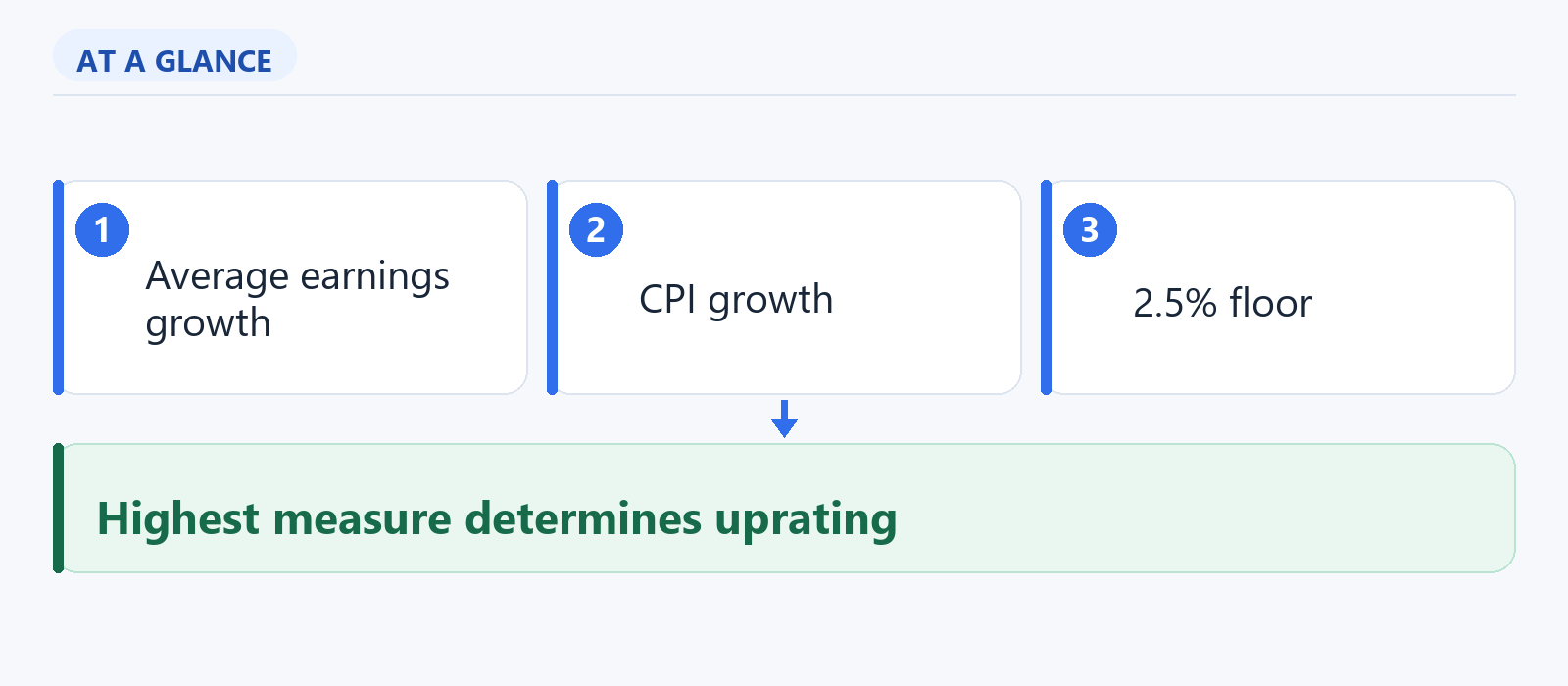
The State Pension triple lock is an annual uprating rule. Under the mechanism described in the available government evidence, the basic State Pension and the full-rate new State Pension are increased by whichever is highest in the relevant comparison:
- average earnings growth;
- Consumer Prices Index (CPI) growth; or
- 2.5%.
In practice, this means the increase is intended to protect the covered State Pension against both rising prices and weak earnings growth, while guaranteeing at least a 2.5% rise under the stated mechanism.
The exact calculation depends on the applicable policy and reference periods. Those operational details are not established by the evidence available here, so the rule should not be used to calculate an individual’s precise payment increase without checking the current official guidance.
How the calculation works
The process can be understood as a three-way comparison:
- Measure the relevant growth in average earnings.
- Measure the relevant growth in CPI.
- Compare both figures with 2.5%.
- Use the highest of the three as the uprating rate for the covered pension.
For example, if earnings growth and inflation were both below 2.5%, the 2.5% floor would be the highest measure. If inflation were higher than both earnings growth and 2.5%, the inflation figure would determine the increase. The same logic applies when earnings growth is the highest measure.
Those examples explain the mechanism rather than specifying the official measurement periods. The available evidence does not establish every reference date or payment-timing detail.
Why people describe it as a “ratchet”
The triple lock can produce a ratchet effect. If one year’s increase is unusually high because earnings or inflation rises sharply, the higher pension amount becomes the starting point for later increases. A subsequent lower rate does not automatically reverse that earlier increase.
This means that an increase above the earnings measure is not subsequently unwound simply because the relevant measure later falls. The effect is cumulative: the higher base can affect future cash increases even when later uprating rates are more modest.
This is a policy-analysis explanation of the mechanism’s possible effect, not a calculation of an individual’s entitlement.
What the triple lock covers—and what it does not necessarily cover
The evidence supports these important limits:
- The rule applies to the basic State Pension and the full-rate new State Pension.
- Some State Pension components from before the 2016 system that fall outside the Triple Lock are described as being uprated by CPI instead.
- The rule does not by itself determine whether someone qualifies for a State Pension or how much they personally receive. It describes how covered amounts are uprated.
Could the rule change?
Yes. The government evidence available for this article describes a planned adjustment to the Triple Lock from April 2030. Therefore, the familiar “highest of earnings, CPI or 2.5%” description should be understood as the mechanism reported in the available evidence and not assumed to remain unchanged indefinitely.
The date matters: a future policy adjustment could change how uprating works after April 2030. Anyone checking an entitlement or planning around a future payment should use the official rules that apply to the relevant year.
Bottom line
The State Pension triple lock works by selecting the highest of average earnings growth, CPI growth and 2.5% for the annual uprating of the basic State Pension and full-rate new State Pension. Its main practical consequence is that unusually large increases can raise the pension’s future baseline rather than being automatically reversed later.
However, it is not a universal increase for every State Pension component, and the available evidence records a planned adjustment from April 2030. It also does not provide all the reference-period or payment-date details needed to calculate an individual’s exact increase.
Leave a Reply